3D Spatial Distance Calculator
Type a common name, IAU designation, or catalog ID (HD, HIP) to search objects, or enter custom coordinates $(\alpha, \delta, d)$. The system computes 3D spatial separation, provides detailed object metadata, and shows full step-by-step calculation breakdowns for both Method A and Method B.
Quick Presets:
Star / Object 1
Input / SearchStar / Object 2
Input / SearchComputed Spatial Distance ($D$)
Parsecs / Light-Years
0.00 pc
0.00 ly
Astronomical Units / km
0.00 AU
0.00 km
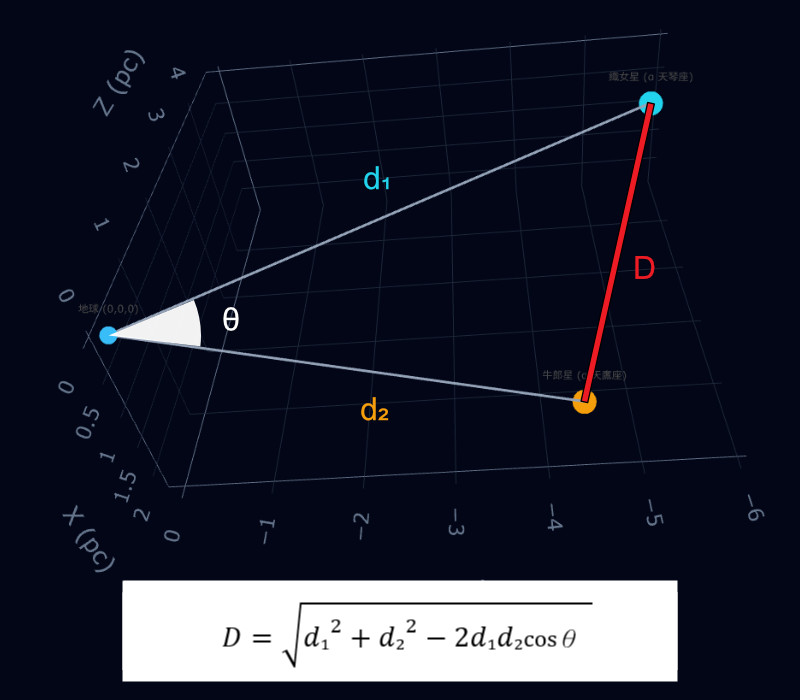
Angular Separation ($\theta$)
0.00°
Radians
0.000 rad
3D Vector Coordinate Map
Drag to rotate • Scroll to zoom
∑ Step-by-Step Mathematical Calculation Steps
Explicit arithmetic walkthrough using current values for Star 1 and Star 2.
Method A: Cartesian Vector Transformation Steps
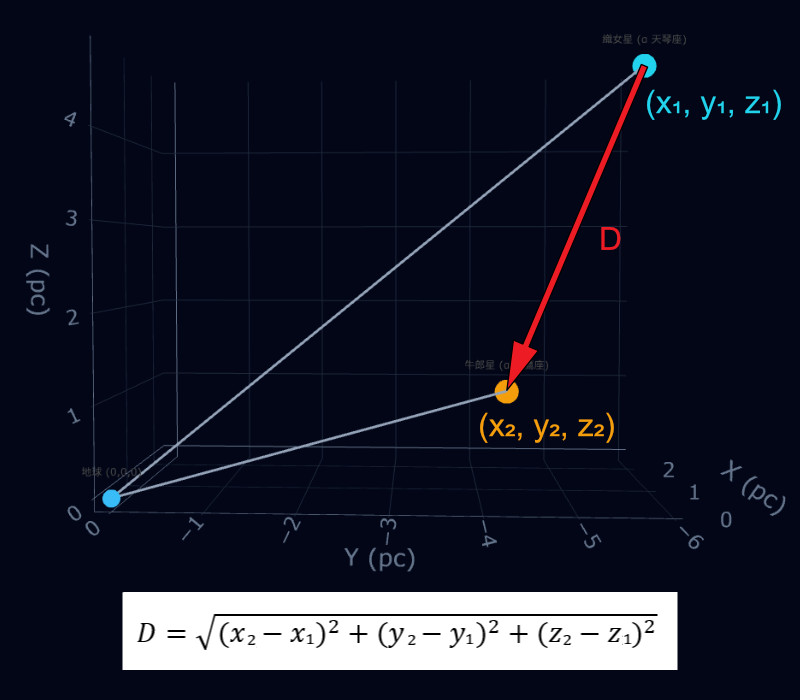
Converts celestial spherical coordinates $(\alpha, \delta, d)$ directly into 3D Cartesian space $(x,y,z)$ relative to Earth at origin $(0,0,0)$, then calculates 3D Euclidean distance.
Step A1.1: Convert Star 1 to $(x_1, y_1, z_1)$
$x_1 = d_1 \cdot \cos(\delta_1) \cdot \cos(\alpha_1)$
$y_1 = d_1 \cdot \cos(\delta_1) \cdot \sin(\alpha_1)$
$z_1 = d_1 \cdot \sin(\delta_1)$
Step A1.2: Convert Star 2 to $(x_2, y_2, z_2)$
$x_2 = d_2 \cdot \cos(\delta_2) \cdot \cos(\alpha_2)$
$y_2 = d_2 \cdot \cos(\delta_2) \cdot \sin(\alpha_2)$
$z_2 = d_2 \cdot \sin(\delta_2)$
Step A2: Compute Component Differences & Euclidean Norm ($D$)
$D = \sqrt{\Delta x^2 + \Delta y^2 + \Delta z^2}$